In my day job, I’m a medical physicist. We put very precise amounts of radiation into people to treat their cancer. To do this effectively, we need to deliver enough radiation to the cancer to achieve the desired effect, but limit the amount that gets to sensitive organs and tissues to keep side effects manageable. We deliver the radiation from multiple angles, at varying intensities. It’s a complex problem of competing priorities. Mathematically, we refer to the development of a treatment plan as an optimization process.
Editing a novel from first draft to final published copy is in many ways it’s own optimization process. And thinking of it this way can help you arrive at a much better final copy.
How People Typically Think of Editing

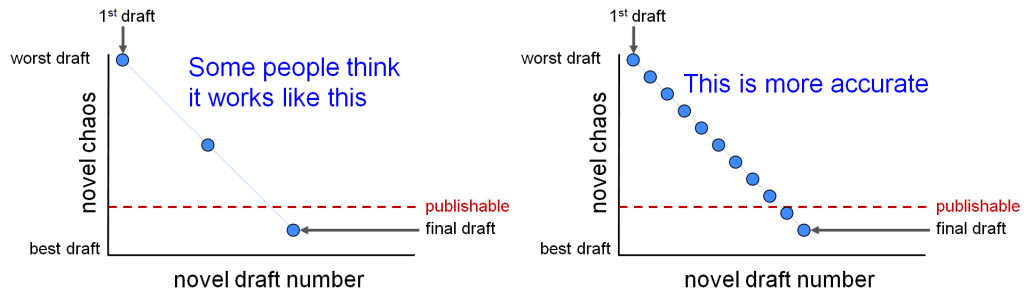
In the image above, I’ve plotted out the way writers typically think of novel editing. You start with a first draft on the top left. It contains a lot of errors, plot holes, inconsistencies… all of which I’ll sum up into a catch-all parameter that I’ll call novel chaos. Each blue dot is a new draft. As time progresses you move from left to right, producing new drafts and with each draft, you fix plot holes, give characters consistent names and eye colors, spell maneuver correctly, etc… you reduce the novel chaos and generate better and better drafts.
Eventually the novel gets good enough and you cross the dashed red line. You now have a novel that is publishable. Incidentally, no one can tell you precisely where that line is. It’s different for different people… agents, publishers, and perhaps most importantly what a potential reader is willing to spend their time and money on. But we know it exists somewhere.
Novice (and sometimes even experienced) writers can be tempted to think that with the completion of a first draft, they’re almost done. But if there’s one thing that I’ve learned about writing is that the lion’s share of the work lies in the editing.
In my blog post From Idea to Published Novel, I talk about all the different types of editing in detail. At the beginning you start with Developmental/Substantive/Structural editing. Here the editor will focus on big picture items like story arc, character arc, themes, pacing, setting, etc. This is often where the biggest changes are made. You figure out where the best place to start the story is. You can tear our entire chapters. Add new chapters. Do complete re-writes.
And here’s one of the key points: sometimes, this editing can make subsequent drafts worse!

But that’s okay.
Why Making It Worse Can Be a Good Thing
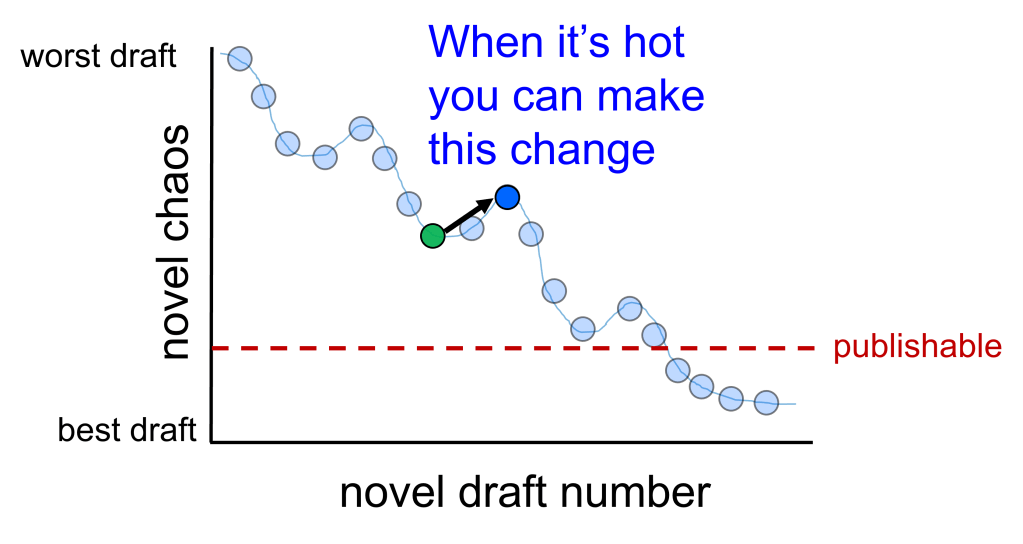
In the figure above, there are cases were the blue dots move up as you go left to right. Why on Earth would anyone want to do that?
Mathematically, in an optimization process, you are often faced with a problem that has a very large number of possible solutions, so large that you can’t just try all of them and select the best one. So instead what you do is try one. You make your best first guess at a solution and see how it works.
If that solution isn’t acceptable, you have to improve it. So you try something else. You make a small change to your best guess solution. If that improves you outcome, you accept that new solution. If not, you stick with the old one.

Then you keep repeating this until you can’t make it any better.
But there’s a problem with this approach…. you can get stuck in spot that’s called a local minimum. No matter what small changes you make, the manuscript won’t get any better. And what happens when you’re not below that “publishable” finish line?

One way of solving this problem involves taking some inspiration from nature, in a process called annealing. This is a heat treatment process that involves heating a material and then slowly cooling it so that the atoms within it migrate within its crystal lattice, so that is ultimately adopts desirable physical and chemical properties. For example, after forging a sword, the metal can be quite brittle and difficult to grind or shape. Annealing softens the blade, making it easier to shape without breaking.
So yes, in a way, you can think of editing your novel like forging a sword!
I won’t go into the details for this blog post, but physicists use a mathematical analog to this heating and cooling process. In the initial stages, the system is very hot. That means that if you find yourself in a local minimum, you are allowed to take steps that make the final solution worse. But as the system cools, the those occasions become less and less frequent, until you get cold enough that you can’t really take them at all.
This allows your solution to escape the local minima traps and march toward the best possible solution.
Applying This to Novel Editing
Once you have your initial draft, you can think of it as a hot system. At the beginning of the editing process, you allow for developmental and major structural changes. These are the BIG changes, where you tear out, re-arrange and re-write chapters. You can cut characters out, or add new ones in. Making these changes first may actually make the novel worse (or at least make it feel that way).
But that’s okay, because it avoids the trap of a mediocre novel.
In this “hot” state is where you want that structural feedback.
Then as you move through subsequent drafts, you cool the system. Those major changes become less probable. You settle in on a narrative structure, a theme, main characters, etc. You align the scenes so that they’ll make sense to a reader.
In a cooler system you start to worry about the smaller details, the language you use, the efficiency of the wording, active voice, showing instead of telling, pacing.
And then when it’s cooler still, you finally get to the nit-picking of proper spelling and grammar and other fine details. In these final stages you’re adding that final polish, searching for phrases you use too often, or cliche terms.
When you look at editing like this, it’s also easy to see why you shouldn’t sweat the small stuff in the first couple drafts. If there’s a possibility you’re going to completely cut out chapter one, there’s not much point in hiring a copy editor to make sure your opening paragraph is grammatically correct!
Update on Lost Command
Speaking of editing, I am now eyeball deep in that for third novel, Lost Command. For what it’s worth, the system is still hot. I’m still in the stages of major structural changes, and when I’m reasonably happy with those, I’ll send it off to my editor who will likely have major structural feedback as well.
Yesterday I realized that I forgot that a minor character was killed. That character came back a couple chapters later, and all the other characters just went with it.
I think they were playing a practical joke on me.
 Charles James SF Author