It’s September and I just finished my last half marathon for the year. It was a gorgeous Saturday morning, cool at the start, hot at the end, no wind. I got to run through the Lethbridge river valley as the cottonwood trees are all transforming into their fall colors. I trained pretty hard for this one, and though I didn’t quite make the time I’d been hoping for, it was a nice conclusion to my running season.
Training for a half marathon is a beast. Particularly if you’ve got a body that’s build more for life as a medical physicist/writer. But this year I decided to get back into long distance running.
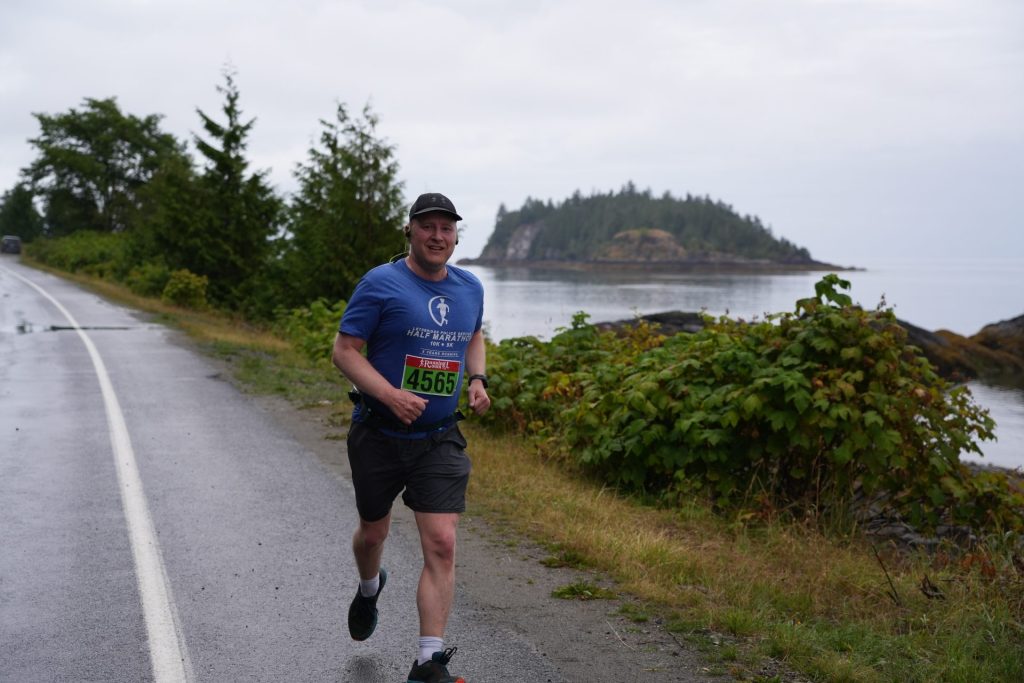
Author Charles James running the final kilometer of the Totem to Totem Half Marathon, Haida Gwaii, BC, summer 2023. Photo credit: TotemtoTotem.com
You make progress in long distance running through consistency. It’s not so much the urge to get out and run fast, but you improve by showing up. My running schedule over the summer included a moderate run on Tuesday evenings (5 – 10 km), a tempo run on Thursdays (5 km), and then progressive distances on the weekends. I started at about 10 km in the beginning and built up to 21 km, then tapered back for race days. I ran on vacation. I ran hills. I ran in the rain.
Writing a novel is a lot like that. You make progress by showing up with consistency. A typical science fiction novel is about 80,000 words long. They can vary of course, but I find that’s a reasonable ballpark for me to aim for. During National Novel Writing Month it takes me about 2 hours of solid writing to meet the daily goal of 1667. So by some quick math, that’s about 96 hours of focused writing, just to produce a first draft. And only about half of that even makes it into the final book!
Writing is a marathon in and of itself.
Astronaut Cassi Requin is back in my latest novel: Fractured Command When her space cruiser is catastrophically damaged in orbit around a black hole, Cassi must improvise, adapt and use every engineering skill she’s learned to hold both her spacecraft and her crew together.
Recently, at the When Words Collide writer’s conference in Calgary, I was on a panel that confronted the ethics of Artificial Intelligence applications in writing. With the rise of Large Language Models like ChatGPT and the capacity for machines to generate stories that are difficult to distinguish from those of human authors, artists are feeling a wide range of emotions.
On the positive side there is excitement and curiosity… AI could boost productivity, help to generate income, and make literature more accessible.
But on the negative side there are fears that AI will take away jobs, and anger that these models have been trained on large bodies of work without fair compensation to those who produced the work in the first place. Even more, writers are feeling threatened because the art of writing had long been seen as a great bastion of creativity, impenetrable by our best machines. But now, it turns out that creative writing is not as computationally complex of a process as we once thought.
So, is the use of artificial intelligence to generate fiction cheating? Is it stealing? Can one still maintain ethical integrity as a writer while using AI-based tools?
Before deep diving into these questions, it’s important to acknowledge various forms of artificial intelligence all around us. Internet search engines use it. Marketing algorithms use it. Social media platforms determine which posts/pictures/videos we see through it. However, the specific context I’m looking at here is the use of Large Language Models (LLMs) such as ChatGPT for the generation of fiction (short stories, novels, scripts, etc.)
Even this context is murky though.
On one hand you can use an LLM to generate an entire manuscript. But you can also use it for prompt generation, brainstorming ideas, research, manuscript organization, and translation. You can ask it for ideas on how to finish a scene that’s not working. You can use it to write a paragraph describing a beach you’ve never been to, or how a car works, or what a fashionable gentleman in 1890s Boston might wear. You can also take a short story produced by an LLM based on your own detailed prompts and edit it until the original draft is unrecognizable.
The line between human and AI-generated work can get blurry in a hurry.
With all of this said, a fellow science fiction author, Ron S Friedman, has been working on some guidelines to help writers navigate the ethical murk of an AI world. Ron was kind enough to share his thoughts with me, and I have built on them. I present my own version these guidelines as a work in progress and invite constructive feedback and discussion from my fellow authors, editors and other creatives in this field.
Writers’ Guidelines for the Ethical Use of AI
1. Disclosure
Those who publish work generated by an artificial intelligence have an obligation to disclose this. Authors have a right to credit for work they have created, but shall not claim credit for work they did not create. In cases where content was collaboratively produced (such as an artificial intelligence wrote the first draft, a human edited the manuscript, or an LLM was used to write the final chapter of a novel), the relative proportion generated by the artificial intelligence needs to be fairly and accurately disclosed.
2. Malicious Use
Artificial intelligence must not be used to intentionally deceive consumers. This includes, but is not limited to deep fakes (misrepresenting the source of the content), the intentional generation or propagation of misinformation, manipulation, coercion, hate speech or other deceitful practices. Fiction must be presented as fiction. Parody must be presented as parody.
3. Informed Consent
Those who use artificial intelligence to produce content need to understand what that technology is doing, consent to the use of the technology, and be in a position to do so freely. No one should be forced, coerced or mislead into using artificial intelligence technology against their will. People have a right to unplug.
Publishers have a right to refuse to publish content generated by artificial intelligence. And they have a right to define what constitutes such content.
Further, artificial intelligence requires data for training. LLMs use large bodies of text for this training. Authors and content creators must give informed consent, and be in a position to do so freely, for their work to be used to train computer models.
And finally, mechanisms need to be in place for consent to be revoked as is reasonable.
4. Fair Compensation
Revenue generated based on the work of content creators, in particular but not limited to those whose work is used for model training, testing and validation, needs to be distributed fairly among those who produced the work.
5. Obligation and the Right to Understand
Users of artificial intelligence have both an obligation and a right to understand how the technology they are using works, what it is capable of, and the reasonable downstream effects of the material it produces.
Concluding Thoughts
At the conference there were some people who believed we were on the edge of something big, that artificial intelligence is going to fundamentally bring about profound changes not just in the writing world, but in many different dimensions of our lives from the media we consume to the news we hear, our spending habits and voting patterns. Indeed, on perhaps a lesser scale it is already doing these things.
But I don’t think it’s something necessarily to be afraid of.
Ethics are rarely simple. And whatever “rules” you come up with can almost always have exceptions. In my own experience, if you start with the intention of treating people fairly, with dignity, honesty and respect, the vast majority of ethical decisions are reasonably straight forward. I think what we really need to be aware of are the pressures that will drive people to turn a blind eye to those things they really should be paying attention to.
Gun fights, sucker punches, duels and last stands… I’ve heard some bad advice on writing combat scenes, some of it gut-wrenchingly horrible. For whatever reason this writing topic seems to be littered with testosterone-infused mansplanations that leave writers confused and left with scenes that instead of pumping readers with adrenaline, just face plant on the canvass. So what gives? In this post I offer some tips on how to keep your readers fully engaged.
I’m sure you’ve heard this first issue: writers not writing fight scenes realistically. Armchair critics love to sit back and point out mistakes: – you’ll break your hand if you bareknuckle punch a guy in the head, – you can’t wake up from head trauma as if you’ve just had a nap, – you won’t be that accurate with a handgun, and ultimately… “it’s not like that in real life.”
Of course not. It’s fiction.
But spaceships can’t travel faster that light, amateur sleuths don’t solve that many murders, and most cowboy billionaire werewolves don’t also have six pack abs.
Writers have multiple objectives with fight scenes. The first and foremost of these is escalation of dramatic tension. The story also has to advance. The reader needs to understand what is happening and the stakes involved.
Fiction is not a how-to manual.
That’s not to say avoid the research. DO thorough research. Dive deeply into the research and understand as much as you can about the details of your combat scene. The reason you do the detailed research is so that while you’re telling the story, you’re not tripping over facts and inconsistencies that when messed up will knock your readers out of the immersive experience of your story. You want to understand what the details are so that when you break from realism, you’re aware of it, and that allows you to sell it.
Know Your Audience
It’s critical to understand the details readers are expecting. A physical confrontation in an action thriller like Mark Greaney’s Gray Man series needs to be accurate, particularly with details of weapon operations. Greaney’s readers will know that difference between a Glock 19 and a Sig P320 and many read specifically for the details of the fictional shooting experience. The bodyguard/cop/Navy SEAL romance crowd are skipping ahead to the abs.
Know your genre. Know what details your audience is expecting, and play to them.
I recently read a cyberpunk book with a glaring “tactical” flaw. The main character was a cyborg military operative whose defining feature was glowing blue eyes. At the beginning of the story, the cyborgs attack at night and the author describes a vivid image of glowing blue eyes advancing out of the darkness.
Anyone with military experience would laugh at that. What they read is a massive tactical mistake… the cyborgs revealing their precise positions to the enemy and thereby negating the whole point of a night attack.
But here’s the thing… the series is selling. It works not because it’s tactically astute, but because it creates imagery consistent with the cyberpunk motif that the readers are looking for.
Establish the Stakes
When using physical conflict to add suspense to a novel, it’s important to establish the stakes of the conflict as early as possible.
Ideally, make them something other than just “survival.” There’s nothing inherently wrong with a character wanting to survive the next page. That can work in a first chapter. But if you’re half way through the book, the action can be a detour from the core question the protagonist is struggling with.
Dramatic tension occurs when something the reader really cares about hangs in the balance of the conflict… the solution to a mystery, the fate of another critical character, the loss of a relationship, etc.
Hand in hand with the stakes is the uncertainty of the outcome.
The outcome of the conflict can’t be a foregone conclusion. If it is, readers will skip it or get bored and put the book down.
Make sure your bad guys have a chance to win. Throw in multiple goons, better weapons, a traitor in the party, sneak attacks, kryptonite, etc. Don’t play fair with your protagonist.
The stakes directly impact the uncertainty of the outcome. A sumo wrestler will likely be able to push drunken patron out of a bar. But what if pushing that patron out is tied to the only means he has of finding his kidnapped son? What if he slips? A mundane task can be incredibly suspenseful if there is enough riding on it.
Set Up a Strategy, Then Knock it Down
Strategy is the plan that you employ to get you where you want to go. Tactics are the individual steps necessary to get you there.
When building up to a physical conflict, it can help to establish a strategy for a character. When a character develops a plan that character has agency in the story. And it gives the reader a chance to engage more deeply–would they do the same thing? Further, a solid plan can help relax the reader into a sense of security, that the important outcome will come up in our favour. And then at any point where the plan fails, that security is lost and dramatic tension escalates. The character has to adapt on the fly. In this way a physical conflict becomes about the character out-thinking the problems presented to them. The physical action serves as punctuation.
There’s a great example of this in the movie Aliens. Ripley and the Colonial Marines are stuck on planet LV-426 after an alien gets on board their drop ship and it crashes. The marines barricade themselves in a colonist atmospheric processing station. They seal access doors, set up robotic sentries and send Bishop, their synthetic human, to a colony transmitter where he can remotely pilot the remaining drop ship down for their rescue. As the aliens attack, each of the points is challenged, and suspense builds.
Another great example of this in Saving Private Ryan. At the end of the movie, Captain Miller (Tom Hanks) and his crew have found Private Ryan, but they have to hold a bridge against a Nazi advance. They plan out their defensive operation… funnel the armor into a narrow street, use a sticky bomb to disable a tank, require their clerk-translator Upham to deliver ammunition as needed, etc. The plan works well for the most part, but every challenge point drips with dramatic suspense. Spielberg With connects each plan point to individual character arcs, the immediate question of whether or not Ryan (Matt Damon) will survive, and with each delivers a ball peen hammer strike on the theme of risking the lives of the many for the few.
Final Thoughts
When you can’t write what you know, research. (Women can effectively wield swords, they aren’t that heavy, and even if they were, women can lift heavy things too.) And seek out beta readers who know more than you. Critical feedback from an external reader is incredibly valuable because they see what you’ve written, not what you initially envisioned.
Ultimately like anything else in your writing, think critically about the action scenes, put as much work into them as your other scenes, and readers will keep turning your pages.
Being a writer means you’re constantly juggling different demands. You have fictitious worlds and characters almost constantly at play in your head, desperately competing for intellectual bandwidth, and the only way you can placate them is by sacrificing time in the physical world, sitting down and organizing them into coherence with words. And I use the word ‘sacrifice’ intentionally, because the time to do that comes with an opportunity cost.
The Writer: [the Writer typing on his computer] Although I hadn’t seen him in more than ten years, I know I’ll miss him forever. Gordon’s Son: Dad, can we go now? The Writer: You ready? Gordon’s Son: Yeah, we’ve been ready for an hour. The Writer: [laughs] Okay, I’ll be right there. His Friend: He said that a half hour ago. Gordon’s Son: Yeah, my dad’s weird. He gets like that when he’s writing.
Stand By Me (Columbia Pictures, Dir. Rob Reiner, 1986)
Being a Dad means a lot of different things. It’s also about juggling demands. You’re a provider, a teacher, a caregiver, a listener, a mentor, a fan, a protector, a cheerleader, a role model, and sometimes a horsey. And one of the most important things you can do for your kids is spend time with them.
Balancing a hobby like writing with fatherhood is a constant challenge. When your kids are young, you do a lot of writing when the kids are asleep, sometime falling asleep at the keyboard yourself. When they get older, you have a little more time, but it comes with guilt… are they on their tablets or other devices too much? Am I going to get up from the computer one day and find that they’re grown up?
To me, being a Dad also means I think more deeply about the content that I put out into the world. First Command and Fractured Command are written to be accessible to ages twelve and up. I try to keep the content family friendly, and limit the foul language, and ultimately publish stories that have positive messages because I know my children will read them.
A few months ago, I was actually invited to my youngest’s primary school to give a reading of First Command.
The ENTIRE SCHOOL had gathered in the gymnasium to listen to the first chapter.
The book, of course, opens with a problem… Astronaut Cadet Cassiopeia Requin has just completed her first faster-than-light transit, a process that gives her horrible motion sickness. Bubbled up in a space suit, her gut rumbles… she’s going to puke! And to make matters worse, this is a practical examination with flight instructors watching her every move.
I was nervous about reading, but the kids loved it!
So many writers I know worry about what their parents might think about their work. But here’s the thing, parents at least have been around the block. They probably know more about you than you think. But one take home message about being a Dad and writer is that your kids WILL read what you’ve written.
To all the Dads out there and those who step into the role… Happy Father’s Day!
Kids have this question thrown at them all the time, all the way through school and even after. We tell them they can be anything they want to be, and then present it like it’s a single choice, like you can pick your career out of a catalogue and once that choice is made, your life is set out for you.
If you’ve ever read through a university calendar or website, you know what I mean. If you choose to study physics… you’re on your way to becoming a physicist. If you choose medicine… you get to be a doctor. If you don’t study anything beyond high school (and take on the debt that comes with it)… you’ll be working menial jobs for the rest of your life.
An education is not a career. When you finish your high school education, the choices that you make aren’t necessarily choices about a career. You choose an educational direction. And of course that’s going to influence your career options. But your education is simply laying a foundation. It can be critically important, but it doesn’t determine what the final house is going to look like.
Anecdotally, I remember a survey of members of the Physics Forums, several years ago that asked whether people ended up where they thought they would be when they entered university. Only a very, very low number found this was true. More than one person mentioned they were working in a field that didn’t even exist when they started! I for one had no idea what medical physics was when I first started my undergraduate studies. I mean… why would anyone want to study how radiation interacts with people when you can study black holes?
So many people feel guilty when the path they’re on isn’t working out. They feel like they’ve failed because they took a wrong turn. And while it’s true, you can’t go back to being 18 again and make different decisions, it’s important to be aware of, and fight against sunken cost effects. If you’re on a career path that’s not working, you can change directions.
And often the sunken cost isn’t quite as sunk as you might think.
As you build your career, the knowledge that you pick up and the skills that you develop are rarely exclusive to a single vocation. My grandfather loved telling a story about how, when he was in high school, he took all these typing classes and then once he got out into the workforce he went for years never using that skill. But then in the late 70s or so, the company he worked for went digital. Everything went computerized and the employees were laid off left right and center. Except… those who could type (and figure out the computer system).
A career is built brick by brick, based on the opportunities one has at the time. It’s the result of a gradual accumulations of many choices over time. And some serendipity.
Nothing in life is to be feared, it is only to be understood. Now is the time to understand more, so that we may fear less.
– Marie Curie
Marie Curie was the first woman to win a Nobel Prize, the first person to with the Nobel Prize twice, and the first person to win in two different fields. She was a true pioneer of modern physics and chemistry.
I find this particular quote inspiring because it underscores the relationship between ignorance and fear. Said another way, people tend to fear what they don’t understand. But it’s not left at that. I find it inspirational because it’s also a call toward learning and education. We are not doomed to live in fear, particularly now, because we live in a time with unprecedented access to information.
I was never fast as a kid. I liked sports like judo, where the outcome of a match wasn’t entirely based on one’s physical prowess. Strategy, technique, the ability to think quickly all played a part in the sport. But running was competitive and almost always a foregone conclusion… the fastest kid would win the race… and it was the same guys all the time.
This is a random picture of a guy (not me) running. Photo by Pixabay on Pexels.com
I once trained hard for a 1600 m (1 mile) race. I was about eight on nine years old. I got up early in the morning and mapped out a route around the block and figured out how many laps I needed for the full 1600 m. I ran that route religiously. It seemed like I did it for months (although to be fair, it was probably every morning for a week–minus Saturday–you know… cartoons). When it came time for the race I came in last. And the same kid who won every other race won that one too.
Fast forward to later in life. My wife started running with her friends at work. She entered a half marathon. Like a loving husband, I watched from the comfort of my camp chair. She and her friends passed and did awesome. But then, I watched as other came in… people that were older than me, heavier, struggling to make it to the finish line. And there I was sitting with a large Slurpee in hand. The point, I realized as we all cheered them in, wasn’t to win, but to do it.
The best exercise is the exercise you do, and even better the exercise you do consistently. And of the biggest keys to consistency is making sure you enjoy it.
When I was focused on the outcome, it was almost impossible to enjoy. If you have ten people in a race, and you’re all or roughly equal physical fitness, the chances of winning are only one in ten, much less so if you’re not the fittest.
But in the words of Baz Luhrmann, the race is long, and in the end it’s only with yourself.
I started running after watching that half-marathon, and I’ve been a runner ever since. I’m still not that fast, but what changed was a mental shift. Running became like a personal meditation… get outside, get the heart rate up, and for the time that I’m out there nothing else really matters… I just keep putting one foot in front of the other.
In a lot of ways, writing is like that too. Just keep putting words down. Eventually you get to the finish line, and in the end, that’s what really matters.
Cassi Requin is back in my latest novel: Fractured Command. When her space cruiser is catastrophically damaged in orbit around a black hole, Cassi, must improvise, adapt, and use every engineering skill she’s learned to hold both her spacecraft and her team together.
I write for an hour each morning. Or at least, I try.
In my house, that’s the quiet time. The kids are still asleep. I have a chance to focus. I slip downstairs, open up a document and get some words down.
Okay, admittedly there’s some distractions there to fight off… checking email, my website, some social media. But when I’m really focusing on my writing, like during NaNoWriMo, I have a simple rule: write 100 words first.
It’s amazing how often that works. The words don’t have to be good. They don’t even really have to make sense. But I find getting about 100 words into a story is often enough to climb over that intellectual hurdle, that action potential that I need to clear in order to reach that immersive writing state sometimes referred to as flow.
The other major part of my morning routine? Honey Bunches of Oats (with Almonds).
Last night I officially launched my second novel, Fractured Command, the second book in the Cassi Requin series. We had a meet and greet, a reading, author Q&A, and of course… time book signing! The event had a great turn out… standing room only for the reading! I’m so grateful for everyone who came out and who has supported me. The event was a great success.
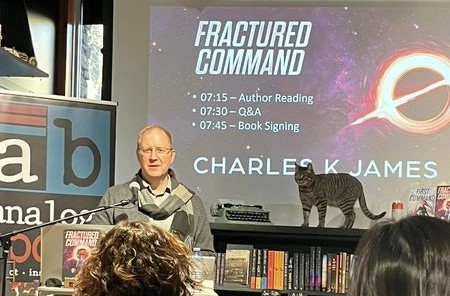
Author Charles James and the book Fractured Command (or First Command) at Analog Books.Hugo, the bookstore cat, offered a “two paws up” endorsement just as I was about to start my reading. I have a feline fan!
The author Question and Answer session was particularly fun for me. Here are a few responses from memory.
What Were the Challenges of Writing a Second Book?
Fractured Command was more challenging to write than First Command. As I understand it, second novels usually are. The series’ protagonist, Cassi Requin, starts out as a cadet in the first book, but now, the cadets have graduated. They are out working in the Alliance Expeditionary Fleet. Cassi has become an engineering officer. When the first book ended, the core characters scattered, and so in the second book we see them re-uniting.
So How Did You Bring Your Characters Back Together?
The book open with a pirate attack on a freighter on which Cassi’s best friend Emica is serving as a flight control officer. When Emica is taken prisoner, Cassi must get her back. To do that, she brings together her team, the survivors from that time on the alien planet.
Why the Black Hole on the Cover?
One of the prominent features of the Fractured Command setting is a black hole, one of the great enigmas of space, an object with gravity so strong, not even light can escape it. While Cassi and her crew don’t actually cross over the event horizon, they get trapped in accretion disk (an asteroid field of old planets grinding each other into pieces) around it. Their spacecraft is horribly damaged, which sets the scene for Cassi to solve ever-escalating problems as one of the surviving engineers.
You Recently Gave a Talk on ChatGPT and AI. Did You Use AI to Write Fractured Command?
No. Not at all.
For what it’s worth, I’m not personally against authors using AI as a tool, any more than I am against using writing prompts or name generators. I think it’s totally acceptable to use AI to help with brainstorming, developing a coherent storyline or character arc, overcome writer’s block, general inspiration, etc. Where I draw the line is using the AI for complete production of a story. There’s still an element of human experience in stories that, while it may be emulated well at some point, won’t ever be true. The human experience is a big part of what we read stories for.
When Can We Expect The Next Book?
These books are about 80,000 words long and I have about 50,000 words of a first draft, with a working title of Lost Command (thanks NaNoWriMo). They’re going to a need a lot of editing though, but I hope to release the third book in the series next year.
I’ve had a lot of great teachers in my life, and I owe a great deal to all of them.
One of the most influential was a teacher that not too many other students liked. He was a curmudgeon of a man with a short grey brush cut and muscular forearms that looked like they were built for strangling students. I’ll call him Mr. Z. The other students in my classes had other names for him… mostly inappropriate. Now that I’m older, I can see that the guy was a hangover from the sixties. Not the Singing Sixties either. (We had other teachers like that.) It was more like the sixties of NASA director Gene Krantz during the Apollo 13 mission… “failure is not an option.”
At the time, my high school has three streams for kids. Basic, General, and Advanced. Advanced was for those kids who were most likely to go on to university, and somehow I ended up in that advanced stream. At the time I had no idea I was going to go on to become a physicist. Going into grade nine I was a relatively average kid in terms of intellectual horsepower. Sure space was cool, but I also wanted to be a private investigator. My parents subtly nudged me, suggesting I try the advanced route and if it was too challenging, I could always drop down.
Mr. Z dropped a challenge on day one.
Science wasn’t just another subject to him. It was the subject. Science was how the world worked. And if we wanted to really make big contributions to the world… become engineers, doctors, scientists, leaders… we had a responsibility to understand the world the best way that we could.
Nothing ever came easy in his class. He took off marks for seemingly trivial things. He assigned (what felt like) mountains of homework. And there were frequent quizzes. I had to come to class prepared… every day.
There were times when I would rather have had a different teacher, someone easier, nicer, someone who might let us slack off just a little.
A lot of people found the guy intimidating. But he laid out the world as he honestly saw it. Not everyone was going to become a movie star. The best way to do anything was to understand as much about it as you possibly could. And as challenging as he could be, for some reason his teaching style resonated with me.








 Charles James SF Author
