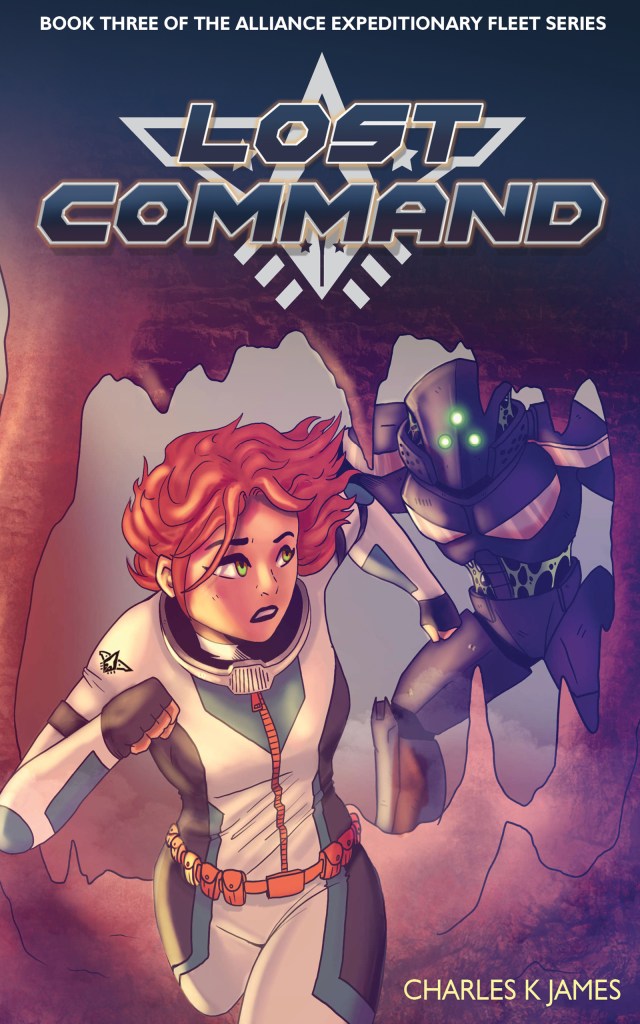
Book III in the Alliance Expeditionary Fleet Universe is coming out now!
Stranded in a galaxy far from home, with no way to call for help, engineering officer Cassi Requin and her crew of survivors make a desperate decision.
They descend to the surface of an unforgiving planet to extract the raw materials they need for repair and replenishment.
But lurking in the shadows lies a relentless enemy Cassi has confronted before—a hive mind sentience that’s out for blood.
Dear Readers, I am extremely proud of this book. It has been a long time coming and I’m so glad that you’ve stuck with me. If you loved the first two books, Book III will not disappoint.
You might notice the covers for the series have been revamped. I’ve commissioned work from a local artist (shout out to Jax Larson) and a local graphic designer (Digital Eye Design). The new art creates a consistent (and awesome!) look across the series.
I’m also proud to state that this book is 100% human-generated. No generative AI was used in the production of any of my books. The book has been edited by Adria Laycraft, so the story structure and quality is up to the standards that you can expect from any major publisher. The suspense, action, and sci-fi thrills are up the standards that you’ve come to expect from this series.
I find myself in such a fortunate position to be supported in my creative endeavors by my family, and friends, and the community of writers and readers in my home town. I can’t thank people enough. Even though each book is the result of long hours of creating and even longer hours of editing, it’s really through the support of the people around me that make it possible.
As the creative world loses its s*** over AI “actress” Tilly Norwood, I relax and drink my morning coffee. There are a lot of impressive things artificial intelligence can do. Replacing the human experience is not one of them.
AI-generated image in response to the prompt: “Woman singing on stage at a rock concert.” It could also have been “woman with severed baby finger sings with back to audience as magic hovering microphone collides with microphone stand.”
When I was a graduate student, I had “mellow mix” CD. I’d pop it in and listen while coding, analyzing, or writing. It would block out the noise and hustle in the lab. One of the songs on it was a live version of Stevie Nicks singing “Landslide.” In 2021, “Landslide” was listed at 163 in Rolling Stone’s “500 Greatest Songs of All Time.” And no doubts here. That song helped me through a PhD thesis.
Nicks wrote “Landslide” in the early 70s. At the time, she was at a crossroads in her life. She was in her mid twenties, and supporting both herself and future Fleetwood Mac guitarist Lindsey Buckingham as a waitress and cleaner. She was thinking about returning to school. But that would mean giving up on her music career, and her relationship with Buckingham. During a visit to Aspen, Colorado, she found her self looking out at the Rocky Mountains. As she put it, she was “pondering the avalanche of everything that had come crashing down on us… at that moment, my life truly felt like a landslide in many ways” (Crystal Visions insert 2007).
Fleetwood Mac achieved worldwide success with their self-titled album a few years later in 1975. But the initial reception of “Landslide” was mixed. One review reported that Nicks seemed “lost and out of place” (Rolling Stone, 1975).
In 1997, a live version was released as a single that was certified gold in 2009. That was the version that I had on my mix CD. There’s a line in that song that really seemed to resonate.
“And I’m getting older, too.”
Really, it’s quite the bold line. For a female singer-songwriter to write that she’s getting older goes entirely against a culture that idolizes youth. It took courage to sing that in 1975. It still would today.
When I listen to the 1975 version and then the 1997 version, there’s difference in that line. She sings the same words. But in 1975 Nicks was only 27 years old. In 1997 she was coming up on 50. In the intervening years there was a world-wide fame, money, drug abuse, numerous relationships, divorce…
In the 1997 version, that line carries a gravitas that just isn’t present in 1975.
That’s because of the lived experience behind it.
Everything we do, everything we say, carries with it a consequence. Sometimes it’s minor. Sometimes it’s life altering. To paraphrase Sam Harris, if I tell you that I honestly believe Elvis is still alive… there’s an immediate social consequence to our relationship. Life comes with an inevitable accumulation of social, physical and psychological consequences.
For better or worse, we drag this experience around with us like Jacob Marley’s ghostly chains.
When humans create art, it’s influence by our lived experience. That’s why art requires courage to put out into the world, particularly as one gets older.
When an artificial intelligence algorithm creates “art” it is, at best, generating a casserole from its training data. The algorithm is not influenced by the accumulation of social, physical, and psychological consequences it its personal history.
The songs that AI will produce 25 years from now might be different because the algorithms will be more advanced. Nuclear-powered server farms and quantum processors might incorporate pleasing patterns in the music yet-to-be discovered. But they won’t carry with them the human experience that makes art what it is.
November is coming. This year it’s going to be different.
For the last quarter century, every November, I’ve participated in (and won) an annual challenge. I write a 50k word novel in 30 days. This crazy endeavor is known as National Novel Writing Month.
But in early 2025, the Office of Letters and Light closed.
Now, if you go to NaNoWriMo.org, all you’ll find is a Go Daddy domain for rent.
The final years of NaNoWriMo weren’t without controversy. There is no need to go into the specifics. But by 2024 many writers just weren’t participating… at least not in any official capacity. And they were losing sponsors. In early 2025, the organizers reported that it was no longer financially viable, and they had to shut down.
How it Began (for me)
I did NaNo for the first time in 2002. I consider myself an early adopter, since it had only officially been running since 1999. The internet was a much simpler place then. No Facebook. No TikTok. Nearly everything was text based. People had to connect through phone lines. And it was filled with the promise of unrestricted access to information.
In 1999 Chris Baty, a writer from San Fransico, and a few others put together the first challenge. And they stumbled onto something big. In the creative world, “flow” is a state of complete immersion in an activity. Creative types crave this state. It’s exciting. It allows one to generate fresh ideas. And it’s productive. What Baty and his group found was that by sacrificing quality for quantity, they reached into this state of creative flow. Story details were easier to remember. Characters took on a life of their own. And at the end of the month, many of them had written entire novels.
The idea caught on. In 2000, about 140 people signed up. In 2001, they were up to 5000. Then when I joined in 2002, they had 14,000 participants from all over the world.
People starting organizing local events… social gatherings to talk about the writing process, brainstorm, and “write-ins” so they could all write together. Collectively, a procrastination of writers would take over a wing of a restaurant, quietly typing away on their laptops. And saving their progress on 3 1/2 inch floppy disks.
At the end of the month I had 50k words toward a crappy novel.
And I mean CRAPPY. A first draft NaNo Novel shouldn’t ever see the light of day. EVER. They’re meant to sit on a hard drive, locked away in the Never Never Land of Stories. Then, there in digital sedimentation, they can be mined for the jewels within.
My first NaNo Novel was the origin story of a modern day ninja. It was inspired by a mix of 80’s Sho Kosugi VHS movies and DVDs like Payback and The Matrix.
Did I mention it was crappy?
Peak NaNoWriMo
I had the fortune to be in Edmonton in the mid-to-late 2000s. A core group of enthusiasts took over the local organization of events brought them up to a “whole ‘nuther level.”
We had plot planning parties, kick-offs with snacks and games, midnight sprints. Some years we organized conference-style workshops, where we would examine story structure and share productivity tips. In October, the online forums would explode with activity. There were hubs for local regions, lounges for your favorite genre and threads where you could read what everyone else was writing. Halloween became NaNoWriMo-Eve. And year after year a core group of writers would return to the exercise, serendipitously generating a community.
For writers, that was huge. Writing is a solitary hobby. NaNo provided a community for a lot of people who otherwise might not have had much social connection at all. (Granted many introverts are just fine with that.) But by 2015, NaNo had over 400k registered participants, and 40k winners!
It carried forward for years. Every November I managed to get my 50k words. By 2022 I had collectively accumulated over 1 million. The books varied. They were all crappy. Most were left unfinished. But the process allowed me to grow as a writer.
One of the great things about NaNo is that you can try out genres you wouldn’t normally spend much time with. Even though I’m primarily a science fiction writer, I’ve tried out action thrillers, fantasies, westerns, and even a horror. Last year I even attempted a romantasy.
We shall not speak of the romantasy, except to say that I brought crappy to a whole ‘nuther level.
NaNoWriMo in 2025
Communities of writers are still out there. If you look for local writing groups, or online communities, you should be able to find others who are still excited about taking on this kind of challenge.
I still am.
You don’t need forums. You don’t need write-ins. You don’t need an Office of Letters and Light.
All you need is a personal commitment to pound out 1667 words per day in November. If you can do that, you’ll have a novel come December 1st.
If you’re like most writers, you find it so much easier to start a story than to finish it. Sometimes you get ten thousand words in. Sometimes you only get a page or so. Then story trails off and hangs in an odd ethereal limbo. You might come back to it, or it might be forgotten forever.
If you start writing a novel, the odds are against you ever finishing. I once crunched some numbers from National Novel Writing Month. Only about 20% of those who started writing a novel, actually finished. Outside of NaNo, I’ve seen numbers on the order of 2-3%.
Why is this?
The usual suspects line up… procrastination, a failure to plan, lack of discipline, self-doubt, life getting in the way, worry that you’re not talented enough…
But here’s a different theory: the underlying mathematics and neuroscience are stacking the deck against you.
Last week I gave a talk at Wordbridge 2025 on time management for writers. One topic I covered was the cognitive demands of creative writing.
Writing creatively actively draws on:
episodic memory – a type of long-term declarative memory that stores personal experiences, events, and their contexts including time, place and emotions,
semantic memory – your factual and conceptual knowledge about how the world works,
free associative thinking – linking of the episodic and semantic memories in a manner that generates coherent fictional ideas,
text formulation – drawing on your lexicon and formulating syntactic structure, adhering to rules of grammar (well some of us), spelling, context, language norms,
controlling the fine motor skills of typing or handwriting,
etc.
It won’t surprise anyone who has tried it that creative writing is a cognitively demanding task.
Now let’s do a little thought exercise. Consider the differences between writing Chapter Two and Chapter One.
Chapter One is all about the creative generation… building characters, events, setting, etc. You write out a scene in relation to whatever conceptual idea(s) you have for the story (if any at all). Then you move it through its natural sequence, doing all those mental tasks mentioned above.
Cognitively, Chapter Two requires all of that, and more. Everything that happens in Chapter Two, needs to be considered in relation to everything that happened in Chapter One. If your gunfighter fires five bullets in the first chapter, he only has one left as you start the second. Fictional facts established as true must continue to be true unless specifically disproved or changed.
Every detail in Chapter Two can potentially be influenced by every detail in Chapter One. Not only are you creating, but you’re also back-checking. That means writing Chapter Two, on average, is a more cognitively demanding task than writing Chapter One.
Now consider Chapter Three.
Just like Chapter Two, the writer has to consider everything that happened prior. Only in Chapter Three, there are now two chapters worth of prior details. To write Chapter Four, you need to keep track of Chapter One through Three. To write Chapter N, you have to keep track of Chapter One through Chapter N-1.
But it’s worse than that even!
There’s interplay to consider. Events and concepts from Chapter One and Chapter Two can affect each other. They can combine to have additional effects in Chapter Three.
Say for example, in Chapter One your main character lands her spaceship on an uninhabited alien planet. The planet doesn’t have a breathable atmosphere so she has to explore in her space suit. Then in Chapter Two, her spaceship blows up. Whether you state it explicitly or not, in Chapter Three she has a problem… she only has whatever air she was carrying with her in her space suit!
As a writer, you have to keep track of all this. You have to keep the story coherent.
To us math nerds, this interplay effect means the cognitive demand grows not just linearly, but exponentially. (One could argue in fact the overall curve is more sigmoidal in shape, because you’re introducing far less new information in Act III than in Act I. And this is why the middle becomes such a muddle. But maybe we don’t need to dive too deeply into the details here.)
The words at the beginning of a novel come far easier than the words later on. This is not because the writer has lost motivation, or lacks self-discipline. The cognitive task of generating more fiction that is consistent with everything already established gets harder as you progress.
It can then be easier to start something new.
That’s why so many writers have hard drives or cloud folders full of orphaned beginnings.
What To Do About It
Of course none of this dooms us as writers to a life of unfinished manuscripts. Here are a few tips to help get you through.
Plotting (vs Pantsing) Plotters (those who start with a story structure before writing), have an advantage over those who don’t. Developing a plan ahead of time reduces the need to carry all that structural logic at once.
Adjust Word Count Goals Give yourself permission to write fewer words per day on the higher number chapters in a project.
Keep a Story Bible A lot of writers will keep a notebook of critical information… character sketches, important plot points, world-building details, etc. Having reference quickly available means less work keeping it all straight in your head.
Take Care of Yourself As with any cognitively demanding task, the more sleep you’ve had, the healthier you’re eating, the more exercise you’re getting, the more socialization and down time you’re getting, etc. the more resilient you’ll be when you’re challenging yourself.
This year for April Fools, I’m posting a few outtakes from my Cassi Requin novels!
These scenes were written in early drafts of my novels First Command, and Fractured Command. And as a special bonus, I’m including an outtake from the new novel Lost Command (coming soon). Each brief scene is just a fragment, possibly embellished from the original goof.
Enjoy.
Zipper Drive
On the second full day of its space trials, while the Steadfast looped out past the eighth planet in the Avalon system, four of its six zipper drives died. They were online and then… not.
“Engineering, what is wrong with my zipper?” Carrideon demanded.
Lieutenant Commander Mantha looked at his terminal, then at Cassi.
Cassi ran through the same diagnostics the engineering chief was looking at. “I think I see the problem, sir.”
“Would you care to elaborate, Ensign?”
Cassi bit her lip, straining to hold the smile back. “Your zipper’s down, sir.”
She couldn’t hold it back and more. Cassi buried her blushing face in her hands and laughed.
As everyone else on set laughed, Mantha looked around. “What’s funny about a downed zipper drive?”
Red Dwarf
“There’s one more thing,” the commanding officer of the Steadfast said. “Master Astronaut Raddock?”
Raddock looked around and wiped sweat from his brow. “Yeah, um… time,” he said. “If the threat of the remaining pieces of our spacecraft breaking up ain’t enough, we’ve got another time constraint here.”
He cleared his throat. “Our remaining power core is at ninety one percent of its maximum capacity. As long as we hold on to the Red Dwarf, it’s gonna keep climbing. We only have a couple hours to make this work. Otherwise, we’ll have to disengage.”
“Don’t you mean the Red Twilight?” Duschene said.
“Yeah. That’s what I said. ‘As long we hold on to the Red Twilight, it’s gonna keep climbing.’”
Sankova covered her mouth in an attempt to hide a giggle. Her face turned pink.
“What?” Raddock asked.
Cassi closed her eyes grabbed Sankova’s shoulder and turned to the signals terminal. The two of them held each other up, trying not to let tears out.
“You said Red Dwarf the first time,” Pelly explained.
“Yeah. So what? Ain’t that like a planet or something?”
Destiny
“Sir, I think I know what the problem is,” Pelly said.
“Go ahead, Mr. Pelly.”
The kid took a deep breath. “We can’t get a fix on our galactic coordinates because the density of the spiral arms are all wrong.”
“What do you mean the destiny is all wrong?” Bauer asked. “We were in the gravity well for a while, but it couldn’t have been so long the galaxy evolved. Could it?”
Everyone on the bridge stared at him.
Bauer put his hands on his hips. “Could it?”
“Of course it couldn’t,” Cassi said, forcing a straight face. “That wasn’t its destiny at all.”
Bauer slapped his forehead with the palm of his hand.
Physics
“Vampire! Vampire! Vampire!” the navigator shouted. “Kinetic rounds launched. Incoming times four.”
Four? Cassi ran through some math. If those slugs had the same shield disruptor technology that was used on the armored freighter, they would get through.
Jetti’s first shot slammed into the Red Twilight’s shields, the charged particles deflected by some mysterious physics that the author planned to figure out later. The spacecraft rolled in response.
Cassi looked up. “Wait a minute. Aren’t you a physicist?” she asked.
It was National Novel Writing Month. The point was to get the story down now and edit it later.
Underwear
“You alright, Zurbling?” Cassi asked.
“Yes, ma’am.”
“No. Seriously.”
He looked up from the relay he was testing, hesitation in his eyes. Something was wrong.
She double checked that they were on a private radio channel. “Feel free to talk to me,” she said. “You’re on my team. If there’s anything bothering you, you can talk to me about it. Okay?”
“Yes, ma’am.” He looked down at the circuit he was working on and took a deep breath. “Someone stole my underwear. Ma’am.”
“What?” Cassi nearly fell over backward.
“That’s the line,” Zurbling said. “See? It’s right here in the script.”
“Isn’t that supposed to be undersuit?” Cassi asked.
“It says underwear,” Zurbling answered.
“It’s a good thing you’re wearing pants!” Quinton called from off-screen. “I thought I was the commando around here.”
Bauer
On her way back to the bridge, Cassi passed the spacecraft’s armory, where the marines slept in cryostasis.
Quinton’s pod was up front with the other officers. He lay there, perfectly still, in suspended animation with his eyes open, staring up into space through the pod’s polymer window.
Someone had taped a picture, face down on the window. Curious, Cassi flipped it up.
Bauer had printed his own smiling face.
“Oh my God! Bauer!”
Quinton bit his lip and giggled, trying to hold still.
“Don’t you start,” Cassi said. “You’re supposed to be in stasis.”
“Hey, I gotta look at that.”
She looked off camera. “Did you seriously put this here?” She read the words scrawled in black marker. “Good Morning, Sunshine? Seriously?”
“Who wouldn’t want to wake up to that?”
“Unbelievable. Here I am… this is like one of the most dramatic moments in the book and you’re all like ‘look at my face.’ Just unbelievable, Bauer.”
Hank You
Cassi lunged at the sentient megaflora—blade first.
She slashed at the main neural network of vines branching off from the cluster. Cassi cut and hanked as hard and as fast as she could, plunging the blade hilt deep in the fleshy cellulose. Not quite wood, but not quite green vine either, the blade stuck.
Cassi looked up. “Hold on. I hanked as hard and fast as I could? How do I even do that?”
Quinton’s muffled voice came from off screen, behind the pressure door to the Red Twilight’s bridge. “It’s a typo. It’s supposed to say Wanked, Cassi.”
The marines laughed.
Cassi’s glare burrowed through the pressure door. “I’ve just been shot like three times. I’m barely alive here. Be serious.”
“I am serious. And don’t call me—”
“Quinton!”
The bridge of the Red Twilight went quiet.
Another muffled marine voice. Thatcher. “You’re in trouble now, mate.
Impressions
Cassi turned and hugged Quinton, deeply and without really thinking it through, she kissed his cheek.
As if she had crossed some kind of line, Cassi pushed away from him, but he was so solidly planted to the ground he didn’t budge and she took a couple steps backward stumbling, the skin on her face a little warmer than it should have been.
The Rhino was waiting, and she didn’t want to make a bad fist impression.
“Wait. What?” Cassi said. “How exactly would I make a bad fist impression?”
In the Hole
Cassi helped Taura drag Lapoint right up to the hull, away from the ejection port. The three of them curled up into tight little balls, pressing their bodies up against the torronite.
Pelly shouted. “TIRE IN THE HOLE!”
“How’d you manage to fit it in there?” Bauer shouted from off-screen.
Pelly looked up. “Huh?”
Taura leaned back. “You said ‘tire’ not fire.”
Still in the Hole
Cassi helped Taura drag Lapoint right up to the hull, away from the ejection port. The three of them curled up into tight little balls, pressing their bodies up against the torronite.
Pelly shouted. “WIRE IN THE HOLE!”
He was already giggling when Taura stood up.
“Pelly!” she shouted. “We’ve got to get through this scene. I have other things to do, you know.”
The kid shook stifled a laugh. “You’re right I’m sorry. Fire in the hole. Fire in the hole.”
Taura rolled her eyes.
In the Hole… This Time With Feeling
Cassi helped Taura drag Lapoint right up to the hull, away from the ejection port. The three of them curled up into tight little balls, pressing their bodies up against the torronite.
Pelly shouted. “TAURA IN THE HOLE!”
Taura jumped up, her hands balled into firsts.
Everyone else on the set laughed.
Taura shook her head. “This is a serious piece of science fiction literature. We’re nearing the climax of the story. This is our big moment. I want to be called back for the sequel.”
Pelly looked off screen. “Wait… there’s a sequel?”
Tactics
“Congratulations, Mr. Pelly.” Mantha leaned back in his seat and checked some readings. “You found a rock.”
He turned his attention to the captain. “Sir, we’re a sitting duck out here. We need that third reactor on-line and those drives operational.”
The other spacecraft flew behind the celestial body, obscured from view.
“They could be using that planetoid to hide some kind of manure,” Pelly said.
Carrideon gafawed, black coffee spit from his nose.
Mantha fell back off his chair.
Pelly shook his head. “Maneuver. Maneuver!”
Cassi laughed. “No no, I’m sure they do want to hide their manure.”
“I wouldn’t have screwed it up if he used the Canadian spelling!” Pelly crossed his arms and stared at the author.
Alezia
“Ready to disembark,” Hazgor ordered. He shouldered his way to the head of the ramp.
There was something of a ceremony to first setting foot on a new planet. Hazgor, as the ranking officer, had a duty to be the first off.
Cassi stood beside him, under the tail. Rain flew sideways and hit her helmet. Droplets collected on her transparent face shield.
Zurbling backed to the side of the ramp next to Hazgor and slipped.
“Ahhh!”
His arms went up in a flair and he tumbled off with a shriek, a roll and a face plant.
“Zurbling?” Cassi called. “Zurbling! Oh my god. Are you okay?”
“I’m fine,” Hazgor answered, rubbing his helmet. “I think he scuffed my face shield though. Is this going to ruin my closeup?”
The young mechanic pushed himself up off the ground. Dark mud clung to his hard-shell suit.
“Sorry. Sorry. My fault.” Zurbling picked him self up, now covered in mud and limping.
“Walk it off. Walk it off.”
Hazgor shook his head. “What if I were to pull off my helmet and then rip off my jacket to show, you know, how as the party leader, I’m not afraid to expose my masculinity to this planet. I would show off my abs. Cover shot!”
“Ew. No.” Cassi said.
“Well hold on,” Emica argued. “We could at least try the scene that way. See how it looks?”
Cassi rolled her eyes. “I’m taking lunch.”
“Great,” Hazgor said as he dashed off the stage. “I’ll get the baby oil.”
A common issue I see with people looking for feedback on their writing is the dreaded prologue. It’s right there on the first page, just waiting to wallop the reader like a frying pan to the head.
While prologues are not inherently evil. Like any other tool, they can, and have been used quite effectively. But as soon soon as I see the word prologue, sitting over that first page in someone’s writing, I have a visceral reaction. It’s like my body is expecting to the work to suck, even before it has a chance to breathe.
When a potential reader opens your book, you generally want to hook them in quickly. Among other things, you want to establish a sympathetic connection to one of your core characters, present them with an intriguing problem or situation, orient the reader in your fictional world, and let them know that this is the book they’re looking for.
A prologue is not a Chapter 1, usually because it involves different characters, or is removed in time or setting from the main story. While it should explain something about the main story, that connection is not always obvious.
As a result, the reader comes in, gets attached to the prologue characters, gets oriented in the prologue world, gets all the feels for the prologue problem, and poof… that’s gone. They have to re-enter the story at Chapter 1. Different time. Different setting. Different characters.
This is an opportunity for the reader to put the book down. And not pick it back up.
As a writer, a prologue puts you in a position where you have to do all that up-front work to hook the reader twice.
When You’re Really Just Worldbuilding
I’ve read a lot of prologues that were info dumps–an assault of information about the fictional world and character backstory without any actual story progression.
Don’t get me wrong. In Science Fiction and Fantasy stories worldbuilding is a huge element of what draws fans in. Many readers want unique, carefully-constructed, special worlds that they can escape into. Learning the idiosyncrasies of your fictional world can make a reader feel like they have access to privileged information. But a poorly executed prologue can often come across as a fire hose blast of information. In that sense, it becomes a roadblock to your story that readers have to slog through before they can get to the good stuff, and that gives them another reason to put the book down.
The trick with worldbuilding is introducing all of those wonderful, unique, intriguing dimensions to your fictional world in digestible chunks. There are lots of tools for doing this… parsing out critical information, inclusion of a newbie or rookie character who doesn’t know the world, critical technology that doesn’t work, subtle hints at a history that’s different from the real world, etc.
The Author is Afraid to Tell The Story
Often writing a new story is like that moment when a movie starts. The lights go down. The production logos come up and your anticipation peaks.
At the beginning, the story is full of potential. All the ideas swirl in your writer’s head and this could be it… the big breakthrough novel!
But as soon as you start writing, get through that first scene or two, the momentous construction you have in mind crashes into reality. And you realize that you’re going to need a whole lot of polish just to make it presentable.
A prologue presents a way to psychologically avoid this crash. Sort of. Because the prologue is not directly connected to the main story, the main story remains locked in that Schrodinger’s box of gleeful uncertainty. The writer can put something out there, and if it’s not a great as they envisioned… well… it’s just the prologue.
Sometimes this goes even further in that the writer doesn’t really know what they want the main story to look like yet. So they write a prologue to introduce themselves to the world.
That’s okay by the way. If you need to write a prologue to grow the story… by all means write it. Just be aware that it doesn’t need to make it into the final draft.
People Skip Prologues
I get a lot of hate when I mention this. For the record, I do read prologues myself. But not everyone does. Some people just flip straight to Chapter 1, because that’s where the story starts. Reading a prologue is like reading a manual for the book. You can always skip back to it when you run into problems. If you have too. But problems that require the reader to go back and look something up in the prologue are going to cause at least some readers to put the book down, and of those, many will not pick it back up, because that’s too much like work.
And because a portion of your audience is going to skip anything labeled prologue, it’s probably not a great idea to have any critical information in it. This creates a dangerous negative reinforcement loop. The more information you keep out, the less critical it is to read. The less critical it is to read, the better it is not to put any critical information in it.
Eventually you just have to start wondering whether your prologue is worth including in the first place.
An Avenue to Boring Writing?
This is just speculation on my part. But when you think about it, if you use a prologue to convey critical information about the characters or the plot, it keeps you from having to work that information into the story. There is less for your characters to discover as the story line moves, and less opportunity to be creative in how you convey that information. Often critical information that characters need to address whatever core problem they’re facing should come at some cost to the character… particularly if you want that character to grow and progress through their arc.
Sometimes writers purposefully add an exciting prologue because they feel their first chapters are otherwise slow. The problem is that even with the exciting prologue, those chapters are still slow.
How to Make It Work
Start by getting the story written. If that means adding a prologue, write a prologue. Get that first draft out on the screen in all its fabulous mediocrity.
But once you have that first draft, start looking for ways to cut out the prologue altogether.
In fact, a number of editors I know have mentioned that it’s quite common in first drafts to find that the first chapter can be cut out entirely. That’s because while the writer first is getting the story down, it’s really challenging to nail down exactly where it starts. The prologue is backstory and the first chapter is the character introduction and the story doesn’t really start until chapter 2. Start where the story starts.
Incidentally deciding on where the story starts is one of those decisions a professional developmental editor can really help you out with.
But let’s say you really, really, really need that prologue.
Of course it can work. There are lots of examples of great books with prologues. A Game of Thrones (George R.R. Martin), The Name of the Wind (Patrick Rothfuss), The Eye of the World (Robert Jordan) all start out with prologues. (Of course there is also a lot of debate on whether these were needed.)
What will really make a prologue work, is that ultimately it’s going to add something of value for your readers. They’ll read it and come away with a sense that it was worth their time to have read that part of the story and that their experience as a whole is better because of it.
Usually this means that on top of having its own hook, there will be something unique about it, but also something familiar that will allow your readers to identify it as the kind of story they want to read. It will also have a clear connection to the main story and that won’t be too much work to discern.
In the original Jurassic Park (Michael Chrichton) novel, the prologue opens with a scene in Costa Rica where an injured worker is helicoptered into a local clinical with wounds supposedly from a construction accident, however it turns out they have come from a “raptor” prompting the reader to question… what the heck is a raptor? Remember, this book came out in 1990, when “raptor” was not a common word in most peoples’ vocabulary. So it was necessary to explain to the reader what it was.
The Jurassic Park prologue worked because not only did it set the hook with some suspenseful foreshadowing, but it managed to introduce a concept that was of core importance to the story and the readers in a short space, it established an ominous tone that would be followed through the novel. Crighton was able to identify and introduce that core concept of dinosaurs in a modern world, and tie it to that nostalgic fascination with dinosaurs that so many people have.
But that said, it’s also important to note though, that modern readers wouldn’t need that same introduction. Most people know what a “raptor” is today.
And please… just don’t let it be the birth story of the Chosen One.
We’re finally back from summer vacation and ready for a new (academic) year. This summer, after attending the When Words Collide Conference in Calgary, my family and I headed out to Ontario, for some end-of-summer fun in cottage country. This is a trip we always look forward too. I get to see my parents, siblings and old friends. My kids get to have fun with their cousins. And we get to enjoy some quality down time that’s an all too precious commodity these days.
What we didn’t know when we set out was that we were on a collision course for one of life’s major emotional moments. And not a good one.
When Words Collide
At the conference, I had the pleasure of attending a talk by Angela Ackerman from the popular Writers Helping Writers team. When the previous session ended, I happened to be in the same room. I stood up to stretch my legs, but the tsunami of incoming people quickly forced me to sit back down and preserve my precious four-legged real-estate. Before the talk even began, all the floor space was spoke for. People were lined up out the door! This was all to hear about a concept called Emotional Amplifiers.
Angela and her co-author Becca Puglisi are well known for their Emotional Thesaurus series of books. These are bibles for many authors and I don’t think I’ve been to a “show don’t tell” workshop yet that doesn’t mention them with high praise. While putting together the original book, Angela spoke about terms collected through their process that weren’t quite emotions, but seemed like they should fit in somewhere. Examples were: stress, pain, hunger, confinement, attraction, illness, and scrutiny. Specifically these are states and conditions that affect a person’s mindset, mood, and ultimately… their emotions. They termed these emotional amplifiers.
One of the jobs of a writer is to expose characters to a relentless sequence of these emotional amplifiers because they ratchet up conflict and drama in a story. Any parent familiar with the term “hangry” knows exactly what I’m talking about. So if a scene is dragging–add in some conditions that crank up the emotional intensity and see what happens.
Of course sometimes fate does the same thing in real life.
Vacation
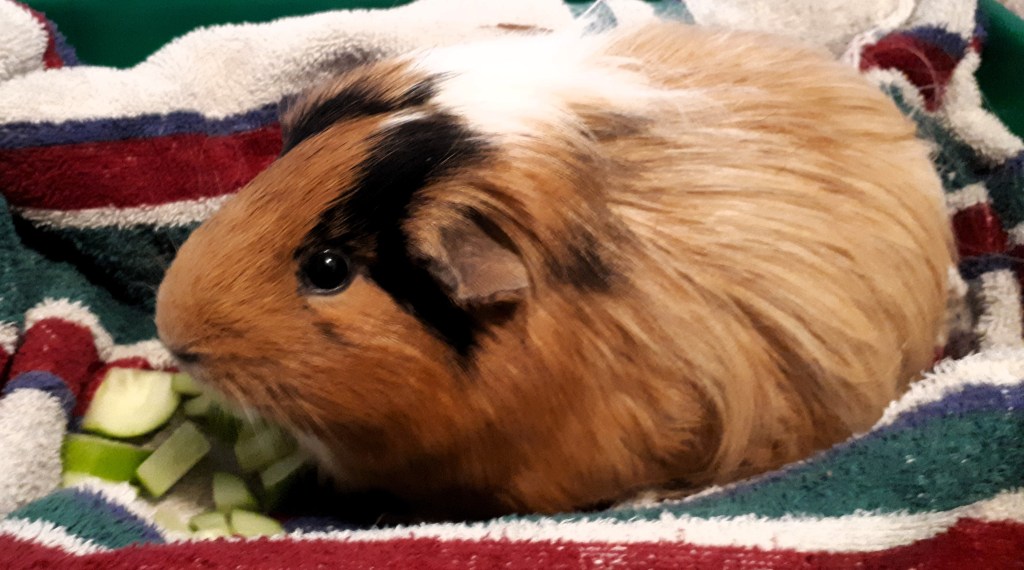
Fast forward to Ontario. About half way through the vacation we got a call from our friend and pet-sitter. One of the Guinea pigs wasn’t doing well. I’ll spare you the details, but after the uncertainty of trying to make her comfortable over the phone, J-Pig quietly passed.
Talk about an emotional amplifier. Telling your kids that a family pet has died sucks.
And the timing could have been better. Here we were, half way across the country, and we had just showed up at my Mom’s cottage. All year our kids look forward to having fun swimming, jumping off the dock, tubing, hiking, making S’mores by the campfire. And now this.
As tough as it was to go through that, it made me realize something quite profound though.
You can experience more than one emotion at a time.
Maybe that’s obvious to people who are a little more in tune with their emotional sides, but to me it was a eureka moment.
You see my kids were worried that the loss of our pet would ruin the vacation. After all, how could we be happy when J-Pig was gone? How guilty would we feel having fun without her?
I think too often we think of emotion as a single state. How are you feeling today? Usually that comes with a one word answer.
But it’s possible to experience joy and happiness, even while you’re mourning. My wife and I explained that it’s okay to give yourself permission to experience those positive emotions, and that it’s not disrespectful to do so, because you can feel both joy and sadness together. We know J-Pig wouldn’t want us to lock out those good feelings, or force ourselves to feel guilt afterward.
I don’t mean to imply this is easy. As a human… you feel what you feel. But understanding it a little more can make it easier to deal with those emotional amplifiers.
And as a writer, this is an important lesson too. If you want to add dimensions to your characters, allow them to experience more than one emotional state at a time.
In my day job, I’m a medical physicist. We put very precise amounts of radiation into people to treat their cancer. To do this effectively, we need to deliver enough radiation to the cancer to achieve the desired effect, but limit the amount that gets to sensitive organs and tissues to keep side effects manageable. We deliver the radiation from multiple angles, at varying intensities. It’s a complex problem of competing priorities. Mathematically, we refer to the development of a treatment plan as an optimization process.
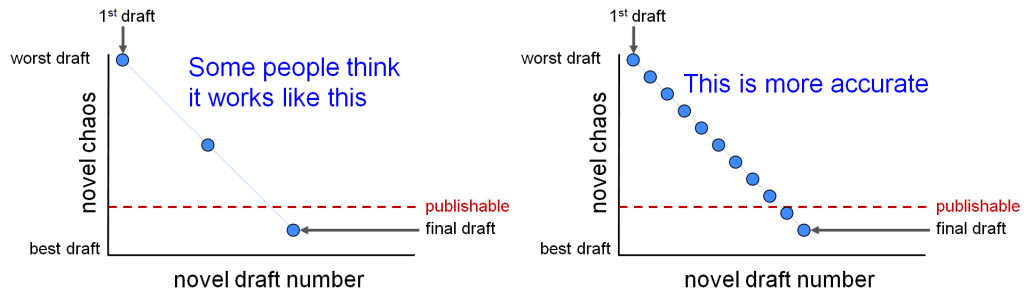
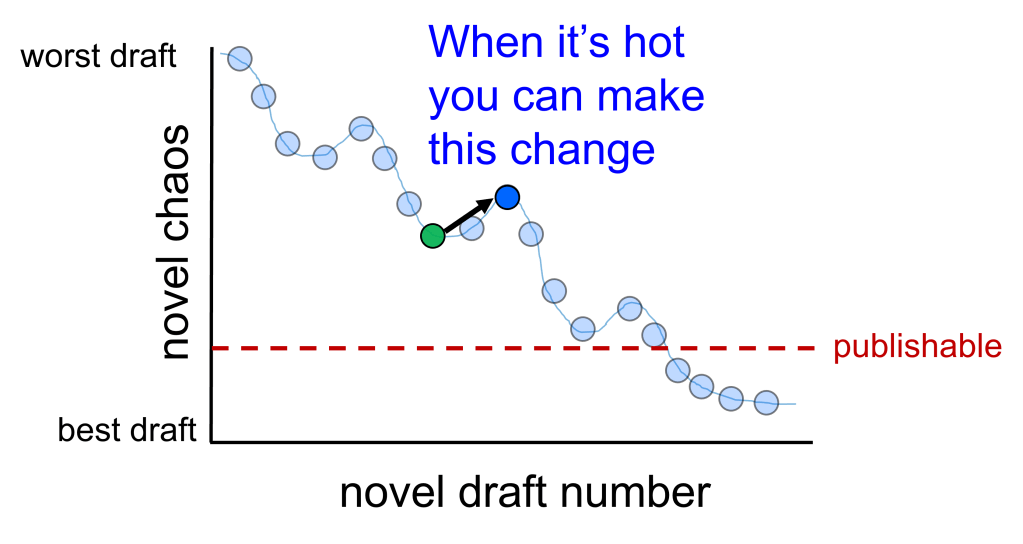
In the image above, I’ve plotted out the way writers typically think of novel editing. You start with a first draft on the top left. It contains a lot of errors, plot holes, inconsistencies… all of which I’ll sum up into a catch-all parameter that I’ll call novel chaos. Each blue dot is a new draft. As time progresses you move from left to right, producing new drafts and with each draft, you fix plot holes, give characters consistent names and eye colors, spell maneuver correctly, etc… you reduce the novel chaos and generate better and better drafts.
Eventually the novel gets good enough and you cross the dashed red line. You now have a novel that is publishable. Incidentally, no one can tell you precisely where that line is. It’s different for different people… agents, publishers, and perhaps most importantly what a potential reader is willing to spend their time and money on. But we know it exists somewhere.
Novice (and sometimes even experienced) writers can be tempted to think that with the completion of a first draft, they’re almost done. But if there’s one thing that I’ve learned about writing is that the lion’s share of the work lies in the editing.
One thing I’ve learned about the process, is that there are a LOT of edits between the first draft and the final draft.
In my blog post From Idea to Published Novel, I talk about all the different types of editing in detail. At the beginning you start with Developmental/Substantive/Structural editing. Here the editor will focus on big picture items like story arc, character arc, themes, pacing, setting, etc. This is often where the biggest changes are made. You figure out where the best place to start the story is. You can tear our entire chapters. Add new chapters. Do complete re-writes.
And here’s one of the key points: sometimes, this editing can make subsequent drafts worse!
The editing process is not linear. Sometimes you have to re-write entire chapters or cut them out entirely. And in doing so, you add in more plot holes, spelling errors, etc. Unfortunately, not every edit you make leads to a net improvement. Sometimes the novel gets worse before it gets better.
But that’s okay.
Why Making It Worse Can Be a Good Thing
In the figure above, there are cases were the blue dots move up as you go left to right. Why on Earth would anyone want to do that?
Mathematically, in an optimization process, you are often faced with a problem that has a very large number of possible solutions, so large that you can’t just try all of them and select the best one. So instead what you do is try one. You make your best first guess at a solution and see how it works.
If that solution isn’t acceptable, you have to improve it. So you try something else. You make a small change to your best guess solution. If that improves you outcome, you accept that new solution. If not, you stick with the old one.
During an optimization, you make a change. If it makes things better, you accept it. If it makes this worse, you don’t.
Then you keep repeating this until you can’t make it any better.
But there’s a problem with this approach…. you can get stuck in spot that’s called a local minimum. No matter what small changes you make, the manuscript won’t get any better. And what happens when you’re not below that “publishable” finish line?
Sometimes you can reach a point where making any small changes won’t improve the novel. This is called a local minimum and it’s easy to get stuck here.
One way of solving this problem involves taking some inspiration from nature, in a process called annealing. This is a heat treatment process that involves heating a material and then slowly cooling it so that the atoms within it migrate within its crystal lattice, so that is ultimately adopts desirable physical and chemical properties. For example, after forging a sword, the metal can be quite brittle and difficult to grind or shape. Annealing softens the blade, making it easier to shape without breaking.
So yes, in a way, you can think of editing your novel like forging a sword!
I won’t go into the details for this blog post, but physicists use a mathematical analog to this heating and cooling process. In the initial stages, the system is very hot. That means that if you find yourself in a local minimum, you are allowed to take steps that make the final solution worse. But as the system cools, the those occasions become less and less frequent, until you get cold enough that you can’t really take them at all.
This allows your solution to escape the local minima traps and march toward the best possible solution.
In simulated annealing, you start out hot, and are allowed to take steps that make your solution worse. But as your system cools, you get fewer of those kind of steps. This allows you to avoid getting stuck at a local minimum.
Applying This to Novel Editing
Once you have your initial draft, you can think of it as a hot system. At the beginning of the editing process, you allow for developmental and major structural changes. These are the BIG changes, where you tear out, re-arrange and re-write chapters. You can cut characters out, or add new ones in. Making these changes first may actually make the novel worse (or at least make it feel that way).
But that’s okay, because it avoids the trap of a mediocre novel.
In this “hot” state is where you want that structural feedback.
Then as you move through subsequent drafts, you cool the system. Those major changes become less probable. You settle in on a narrative structure, a theme, main characters, etc. You align the scenes so that they’ll make sense to a reader.
In a cooler system you start to worry about the smaller details, the language you use, the efficiency of the wording, active voice, showing instead of telling, pacing.
And then when it’s cooler still, you finally get to the nit-picking of proper spelling and grammar and other fine details. In these final stages you’re adding that final polish, searching for phrases you use too often, or cliche terms.
When you look at editing like this, it’s also easy to see why you shouldn’t sweat the small stuff in the first couple drafts. If there’s a possibility you’re going to completely cut out chapter one, there’s not much point in hiring a copy editor to make sure your opening paragraph is grammatically correct!
Update on Lost Command
Speaking of editing, I am now eyeball deep in that for third novel, Lost Command. For what it’s worth, the system is still hot. I’m still in the stages of major structural changes, and when I’m reasonably happy with those, I’ll send it off to my editor who will likely have major structural feedback as well.
Yesterday I realized that I forgot that a minor character was killed. That character came back a couple chapters later, and all the other characters just went with it.
At the beginning of 2024 I set a goal of writing at least 500 words per day toward my next book, tentatively titled Lost Command. Here’s how it’s going.
The premise behind all of this was to set a relatively easy goal, but to be consistent with it. Sure, I can write more than 500 words. Sometimes during National Novel Writing Month I can write over 2000 words in a day. I’ve never kept track, but occasionally, if I can clear everything else off my plate I’ve gotten into the 5000 word ballpark. But like running marathons, that pace isn’t sustainable. Not for a guy like me with a family and a demanding day job.
So I’m happy to report that by the end of February, I crossed the 60k mark!
A snapshot of my cumulative word count on Lost Command, January through March 2, 2024.
This puts me at about three quarters of the way through the first draft. More importantly, I’m through the middle of the story. I’ve heard it said that middles should more aptly be called “muddles” because you have to muddle your way through. In my experience, as you get closer to the end, the story gets easier to write because you stop introducing new information, the challenges are set, the key players are in place, and now the writing is all about trying the story together, having the main character confront their ultimate challenges and grinding through to victory (or defeat) in a satisfying conclusion. (And because it’s a first draft that conclusion doesn’t even have to be all that satisfying!)
Incidentally in February I took up the push-up challenge as well. I think, formally the goal was to get 2000 push-ups in by Feb 23rd. I never formally signed up, but I figured I might try. And check this out.
I managed well over 3000 push-ups through the month of February.
This wasn’t so much an easy challenge. Doing over 100 push-ups in a day can be pretty hard on the body, if you’re not used to it. But I got through it by breaking it down into sets of 20 at first and then rising to 25, 30, and even more. While in the end, it’s not like I get much out of this, but I think it’s just another demonstration of how small, regular efforts accumulate, enabling one to reach much larger goals.
I can’t believe I’ve been working on it for as long as I have. Last year I set out with a simple goal at the end of January of writing at least 500 words per day on the manuscript. And I’m happy to report… it worked! I had a first draft completed by about May.
Revisions, Revisions, Revisions…
Then came the revisions. As I’ve mentioned previously, in my process, the polish comes through editing. Once a you have a completed first draft of a novel you can’t just publish. (Or at least I can’t.) I set out on the process of revisions. For me there are at least two more major revisions that come after the first draft, plus many minor revisions, before it goes out to an external editor.
By the summer I had a draft I was happy with… and then it was off to my amazing editor Adria. It’s important to me that all books that come out of Megavoltage Publishing are professionally edited. Lots of people refer to “self-published” books, but I’ve always preferred the term independently published. The work that I put out into the world goes through the same process it would get from other small publishers, and my readers ultimately get to enjoy a story that is just as polished.
When Lost Command came back, I had some work cut out for me. I didn’t plan for it to take the entire fall to address them, but the thing with day jobs is that you can’t always control how much time you have to put into your writing. They’re done, addressed, and the manuscript has had another couple of passes. Currently it’s back with my editor for the second pass.
What I Can Say… Without Spoilers…
Like many third books, in Lost Command we’ll see a return of all of major characters, and we’ll introduce several new ones. The book continues with themes of leadership and perseverance, and elements from both book I and book II will re-emerge. It will include hostile aliens, suspenseful technical challenges, the heart-pounding combat sequences that have come to characterize the series.
Looking Forward…
When the second round of edits come back, I’ll triage the damage and come up with a plan of attack for the revisions. I’m not expecting those to take too long this cycle. One those are done, I do a “backward” edit, where I essentially go through the manuscript backwards because reading it that way helps to catch errors. Then the book goes out to my advanced copy team of readers–for whose efforts I am extremely grateful. In parallel, I’ll contract my cover designer and get started on that process.
With all of that said, I’m aiming to launch Lost Command in Early spring 2025.
Also, I am planning to write at least one more book in the series.









 Charles James SF Author