Why Most Stories Go Unfinished…

If you’re like most writers, you find it so much easier to start a story than to finish it. Sometimes you get ten thousand words in. Sometimes you only get a page or so. Then story trails off and hangs in an odd ethereal limbo. You might come back to it, or it might be forgotten forever.

If you start writing a novel, the odds are against you ever finishing. I once crunched some numbers from National Novel Writing Month. Only about 20% of those who started writing a novel, actually finished. Outside of NaNo, I’ve seen numbers on the order of 2-3%.

Why is this?

The usual suspects line up… procrastination, a failure to plan, lack of discipline, self-doubt, life getting in the way, worry that you’re not talented enough…

But here’s a different theory: the underlying mathematics and neuroscience are stacking the deck against you.

Last week I gave a talk at Wordbridge 2025 on time management for writers. One topic I covered was the cognitive demands of creative writing.

Writing creatively actively draws on:

  • episodic memory – a type of long-term declarative memory that stores personal experiences, events, and their contexts including time, place and emotions,
  • semantic memory – your factual and conceptual knowledge about how the world works,
  • free associative thinking – linking of the episodic and semantic memories in a manner that generates coherent fictional ideas,
  • text formulation – drawing on your lexicon and formulating syntactic structure, adhering to rules of grammar (well some of us), spelling, context, language norms,
  • controlling the fine motor skills of typing or handwriting,
  • etc.

It won’t surprise anyone who has tried it that creative writing is a cognitively demanding task.

Now let’s do a little thought exercise. Consider the differences between writing Chapter Two and Chapter One.

Chapter One is all about the creative generation… building characters, events, setting, etc. You write out a scene in relation to whatever conceptual idea(s) you have for the story (if any at all). Then you move it through its natural sequence, doing all those mental tasks mentioned above.

Cognitively, Chapter Two requires all of that, and more. Everything that happens in Chapter Two, needs to be considered in relation to everything that happened in Chapter One. If your gunfighter fires five bullets in the first chapter, he only has one left as you start the second. Fictional facts established as true must continue to be true unless specifically disproved or changed.

Every detail in Chapter Two can potentially be influenced by every detail in Chapter One. Not only are you creating, but you’re also back-checking. That means writing Chapter Two, on average, is a more cognitively demanding task than writing Chapter One.

Now consider Chapter Three.

Just like Chapter Two, the writer has to consider everything that happened prior. Only in Chapter Three, there are now two chapters worth of prior details. To write Chapter Four, you need to keep track of Chapter One through Three. To write Chapter N, you have to keep track of Chapter One through Chapter N-1.

But it’s worse than that even!

There’s interplay to consider. Events and concepts from Chapter One and Chapter Two can affect each other. They can combine to have additional effects in Chapter Three.

Say for example, in Chapter One your main character lands her spaceship on an uninhabited alien planet. The planet doesn’t have a breathable atmosphere so she has to explore in her space suit. Then in Chapter Two, her spaceship blows up. Whether you state it explicitly or not, in Chapter Three she has a problem… she only has whatever air she was carrying with her in her space suit!

As a writer, you have to keep track of all this. You have to keep the story coherent.

To us math nerds, this interplay effect means the cognitive demand grows not just linearly, but exponentially. (One could argue in fact the overall curve is more sigmoidal in shape, because you’re introducing far less new information in Act III than in Act I. And this is why the middle becomes such a muddle. But maybe we don’t need to dive too deeply into the details here.)

The words at the beginning of a novel come far easier than the words later on. This is not because the writer has lost motivation, or lacks self-discipline. The cognitive task of generating more fiction that is consistent with everything already established gets harder as you progress.

It can then be easier to start something new.

That’s why so many writers have hard drives or cloud folders full of orphaned beginnings.

What To Do About It

Of course none of this dooms us as writers to a life of unfinished manuscripts. Here are a few tips to help get you through.

  • Plotting (vs Pantsing)
    Plotters (those who start with a story structure before writing), have an advantage over those who don’t. Developing a plan ahead of time reduces the need to carry all that structural logic at once.
  • Adjust Word Count Goals
    Give yourself permission to write fewer words per day on the higher number chapters in a project.
  • Keep a Story Bible
    A lot of writers will keep a notebook of critical information… character sketches, important plot points, world-building details, etc. Having reference quickly available means less work keeping it all straight in your head.
  • Take Care of Yourself
    As with any cognitively demanding task, the more sleep you’ve had, the healthier you’re eating, the more exercise you’re getting, the more socialization and down time you’re getting, etc. the more resilient you’ll be when you’re challenging yourself.

Learn the Optimization Process: From First Draft to Published Novel

In my day job, I’m a medical physicist. We put very precise amounts of radiation into people to treat their cancer. To do this effectively, we need to deliver enough radiation to the cancer to achieve the desired effect, but limit the amount that gets to sensitive organs and tissues to keep side effects manageable. We deliver the radiation from multiple angles, at varying intensities. It’s a complex problem of competing priorities. Mathematically, we refer to the development of a treatment plan as an optimization process.

Editing a novel from first draft to final published copy is in many ways it’s own optimization process. And thinking of it this way can help you arrive at a much better final copy.

How People Typically Think of Editing

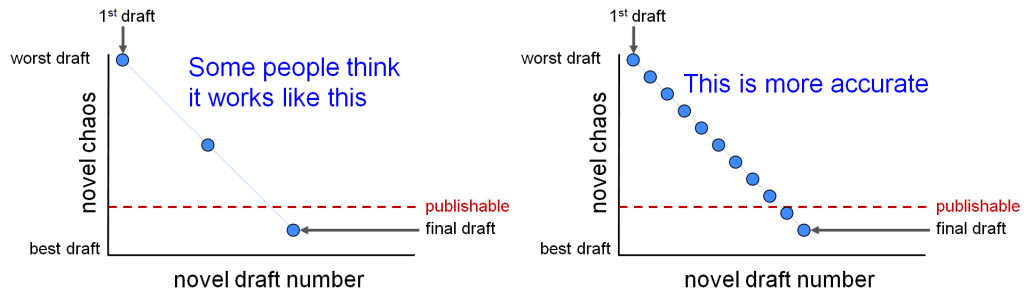
The process of novel editing shown on a graph.

In the image above, I’ve plotted out the way writers typically think of novel editing. You start with a first draft on the top left. It contains a lot of errors, plot holes, inconsistencies… all of which I’ll sum up into a catch-all parameter that I’ll call novel chaos. Each blue dot is a new draft. As time progresses you move from left to right, producing new drafts and with each draft, you fix plot holes, give characters consistent names and eye colors, spell maneuver correctly, etc… you reduce the novel chaos and generate better and better drafts.

Eventually the novel gets good enough and you cross the dashed red line. You now have a novel that is publishable. Incidentally, no one can tell you precisely where that line is. It’s different for different people… agents, publishers, and perhaps most importantly what a potential reader is willing to spend their time and money on. But we know it exists somewhere.

Novice (and sometimes even experienced) writers can be tempted to think that with the completion of a first draft, they’re almost done. But if there’s one thing that I’ve learned about writing is that the lion’s share of the work lies in the editing.

One thing I’ve learned about the process, is that there are a LOT of edits between the first draft and the final draft.

In my blog post From Idea to Published Novel, I talk about all the different types of editing in detail. At the beginning you start with Developmental/Substantive/Structural editing. Here the editor will focus on big picture items like story arc, character arc, themes, pacing, setting, etc. This is often where the biggest changes are made. You figure out where the best place to start the story is. You can tear our entire chapters. Add new chapters. Do complete re-writes.

And here’s one of the key points: sometimes, this editing can make subsequent drafts worse!

The editing process is not linear. Sometimes you have to re-write entire chapters or cut them out entirely. And in doing so, you add in more plot holes, spelling errors, etc. Unfortunately, not every edit you make leads to a net improvement. Sometimes the novel gets worse before it gets better.

But that’s okay.

Why Making It Worse Can Be a Good Thing

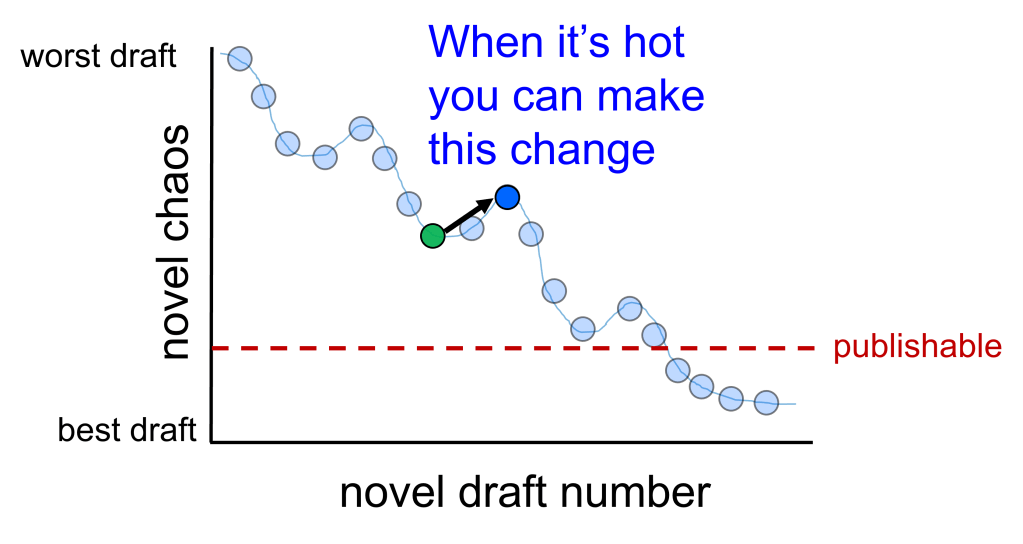
In the figure above, there are cases were the blue dots move up as you go left to right. Why on Earth would anyone want to do that?

Mathematically, in an optimization process, you are often faced with a problem that has a very large number of possible solutions, so large that you can’t just try all of them and select the best one. So instead what you do is try one. You make your best first guess at a solution and see how it works.

If that solution isn’t acceptable, you have to improve it. So you try something else. You make a small change to your best guess solution. If that improves you outcome, you accept that new solution. If not, you stick with the old one.

During an optimization, you make a change. If it makes things better, you accept it. If it makes this worse, you don’t.

Then you keep repeating this until you can’t make it any better.

But there’s a problem with this approach…. you can get stuck in spot that’s called a local minimum. No matter what small changes you make, the manuscript won’t get any better. And what happens when you’re not below that “publishable” finish line?

Sometimes you can reach a point where making any small changes won’t improve the novel. This is called a local minimum and it’s easy to get stuck here.

One way of solving this problem involves taking some inspiration from nature, in a process called annealing. This is a heat treatment process that involves heating a material and then slowly cooling it so that the atoms within it migrate within its crystal lattice, so that is ultimately adopts desirable physical and chemical properties. For example, after forging a sword, the metal can be quite brittle and difficult to grind or shape. Annealing softens the blade, making it easier to shape without breaking.

So yes, in a way, you can think of editing your novel like forging a sword!

I won’t go into the details for this blog post, but physicists use a mathematical analog to this heating and cooling process. In the initial stages, the system is very hot. That means that if you find yourself in a local minimum, you are allowed to take steps that make the final solution worse. But as the system cools, the those occasions become less and less frequent, until you get cold enough that you can’t really take them at all.

This allows your solution to escape the local minima traps and march toward the best possible solution.

In simulated annealing, you start out hot, and are allowed to take steps that make your solution worse. But as your system cools, you get fewer of those kind of steps. This allows you to avoid getting stuck at a local minimum.

Applying This to Novel Editing

Once you have your initial draft, you can think of it as a hot system. At the beginning of the editing process, you allow for developmental and major structural changes. These are the BIG changes, where you tear out, re-arrange and re-write chapters. You can cut characters out, or add new ones in. Making these changes first may actually make the novel worse (or at least make it feel that way).

But that’s okay, because it avoids the trap of a mediocre novel.

In this “hot” state is where you want that structural feedback.

Then as you move through subsequent drafts, you cool the system. Those major changes become less probable. You settle in on a narrative structure, a theme, main characters, etc. You align the scenes so that they’ll make sense to a reader.

In a cooler system you start to worry about the smaller details, the language you use, the efficiency of the wording, active voice, showing instead of telling, pacing.

And then when it’s cooler still, you finally get to the nit-picking of proper spelling and grammar and other fine details. In these final stages you’re adding that final polish, searching for phrases you use too often, or cliche terms.

When you look at editing like this, it’s also easy to see why you shouldn’t sweat the small stuff in the first couple drafts. If there’s a possibility you’re going to completely cut out chapter one, there’s not much point in hiring a copy editor to make sure your opening paragraph is grammatically correct!

Update on Lost Command

Speaking of editing, I am now eyeball deep in that for third novel, Lost Command. For what it’s worth, the system is still hot. I’m still in the stages of major structural changes, and when I’m reasonably happy with those, I’ll send it off to my editor who will likely have major structural feedback as well.

Yesterday I realized that I forgot that a minor character was killed. That character came back a couple chapters later, and all the other characters just went with it.

I think they were playing a practical joke on me.

7 Tips to Increase Productivity for Writers

Photo by Pixabay on Pexels.com

It always amazes me when I read about writers who can put out several books per year. Getting a book written, edited and out on the market is hard work, particularly when you have to balance family responsibilities, a demanding day job and keep all the other elements of your life in balance. One might think that during a pandemic, being forced into lockdowns with nowhere to go and not much else to do, a writer could be more prolific, but a lot of writer friends of mine are finding it quite the opposite. It takes a lot of mental energy to block out the real world and create something within a fictional one. Fighting off anxiety, having more (or in some cases much less) ‘alone time,’ spending more and more hours working online, not being able to blow off steam with friends… it can add up to a massive creative void.

And yet people are still producing great fiction. Here are a few ideas for my writer friends on how to to be more productive…

  1. Setting SMART Writing Goals
    You’ve probably heard of SMART goals already, but I think when it comes to productivity, taking time at the “executive” level to establish what is you want to accomplish can make a world of difference. When it comes to setting writing goals, you want to make goals that are:
    1. Specific
      Rather than “write a novel” which is vague, be more specific… complete a novel outline, complete a first draft manuscript, sent out 10 query letters, etc.
    2. Measurable
      How will you measure your progress?  How will you know when you’re finished? One great example of this is setting word count goals.
    3. Attainable
      Given all the commitments you have in your life, is it reasonable for you to achieve this goal? Of course you can challenge yourself. But part of good adulting is learning to judge what’s reasonable.
    4. Relevant
      It’s important to spend time thinking about the big-picture.  Where do you want to be with your writing in five years?  Are your immediate goals consistent with that?
    5. Time-Constrained
      Time limits are important, even if they’re only self-imposed.  When you don’t have a deadline, anything else that does have one will take priority over your goal, which makes it that much more challenging to complete.
  2. Tell Other People About Your Goals
    Most people want to see other people around them achieve their goals. (One could argue that most great fiction is based on this single fact.) When you tell people what your goals are, you’re defining them in a concrete manner, and making a kind of commitment that at very least you’re likely to be asked about in the future. It also helps the people around you to understand where your priorities lie.
  3. Find Some Writing Buddies
    As fun as writing is, it tends to be a solitary hobby.  Having at least one other person you can talk to about your creative journey can help keep you inspired and accountable to your goals. Look for people who have similar goals and write in similar genres if possible. And making time for positive socialization is also a part of taking good care of yourself.
  4. Write 100 Words First
    Something that really helps me during National Novel Writing Month is to write 100 words as soon as I sit down.  Do that before you open an internet browser or check your email, or do any of those other pre-writing rituals. I know, for a lot of people those are important, but one thing that I’ve found is that often getting through that first 100 words can trigger those writing centres in your brain that it’s time to write.  And then, even if you fall into a black hole of procrastination and end up with nothing else for the rest of the session, you at least put 100 words down.
  5. Make Writing a Regular Habit
    When you have a regular writing period in your daily or weekly schedule it’s that much easier to tell other people that this is your writing time. You can defend it. You can organize (most) other responsibilities around it. And if inspiration doesn’t show up the moment you sit down and start working, you can at least have the satisfaction of looking up from your desk with a scowl when it tries to sneak in and say, “you’re late!”
  6. Leave on a High Note
    Its always tempting to write through a scene and stop only when you get to a natural break. But consider stopping the middle of scene. Even in the middle of a sentence. That will make it easier to start again the next day because you’ll know what to write next.
  7. Foster Resilience in Yourself
    This is one of those little tidbits that we all know on some level, but sometimes need to be reminded of.  By taking care of yourself, I mean getting adequate sleep (and not replacing sleep with caffeine), exercise, and nutrition… on a regular and ongoing basis. It can almost seem counter-intuitive at first. Taking time to work out can cut into valuable writing time, but life is all about balance. The point is that when you’re as healthy and alert as you can be, that will help with all the executive *willpower* tasks that you need to exercise personal discipline and stay on track as you work.

CJ